Start with your market.
Define the companies you can genuinely help: companies suited to your software use case. Keep your offer, geography and exclusions in the brief.

Keep prospecting tied to your product, your use case and the companies most likely to benefit. Start with account fit, then look for a credible reason to engage.
For: B2B SaaS businesses and software providers with a defined business customer profile.
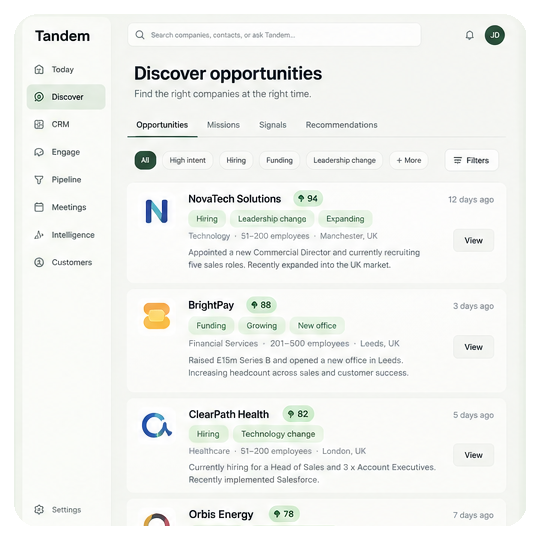
Prioritise companies around the use case you solve, with changes that support research rather than generic buying-intent claims.
Define the companies you can genuinely help: companies suited to your software use case. Keep your offer, geography and exclusions in the brief.
Research relevant, sourced changes rather than guessing at buying intent. For this example, look for relevant team growth.
Review the account and the source before accepting it, finding a contact or preparing an approach within your package and controls.
Hiring or headcount changes linked to your product’s use case.
Public changes worth assessing against your ideal account profile.
Use only reliable, available evidence. Do not infer an unseen software stack.
Signal coverage depends on available sources. A technology mention does not prove current usage, a replacement project or buying intent.
Examples describe a targeting approach, not guaranteed results or universal source coverage. Confirm available data, signals and enabled workflows in your assessment. No outreach is implied by reviewing a company.
Start with the free assessment. Explore where Tandem fits your business, then discuss the right scope, sources and package.